
Vertical Blinds Singapore: Your Complete Buying Guide
By Prime Decor Furnishing
Vertical Blinds Singapore: Your Complete Buying Guide
What vertical blinds in Singapore offer you right now
The best vertical blinds for Singapore homes and offices combine PVC or fabric vanes with a top-mounted track system, giving you precise light control and clean access to sliding doors without the bulk of curtains. Primedecorfurnishing supplies custom vertical blinds with free onsite measurement, professional installation, and a product warranty — covering everything from HDB flats to commercial offices.
Here is what you get with a well-specified set of vertical window blinds:
- Light control: Tilt the vanes to any angle or draw them fully open for unobstructed access to your sliding door.
- Privacy on demand: Full closure blocks sightlines completely, which matters in ground-floor HDB units and street-facing offices.
- Durability: PVC and faux wood vanes resist Singapore’s humidity without warping or fading.
- Custom sizing: Tracks and vanes are cut to your exact window or door dimensions, not approximated from a standard size.
- Warranty coverage: Primedecorfurnishing backs its products with a warranty and offers after-sales support.
The service package at Primedecorfurnishing includes:
- Free home consultation and measurement
- Fabrication to your exact specifications
- Professional installation by trained fitters
- Post-installation warranty and servicing
Pro Tip: Book your free measurement before finalizing your renovation timeline. Fabrication takes time, and scheduling installation after other trades finish prevents damage to new vanes.
Table of Contents
- Why vertical blinds work so well for large windows and sliding doors
- Which material should you choose for Singapore’s climate?
- How to keep your vertical blinds clean and lasting longer
- What does it cost to buy and install vertical blinds in Singapore?
- Can you automate your vertical blinds with a smart home system?
- Why S-shaped vanes give your vertical blinds a more polished finish
- Primedecorfurnishing brings it all together for Singapore homeowners
- Key Takeaways
Why vertical blinds work so well for large windows and sliding doors
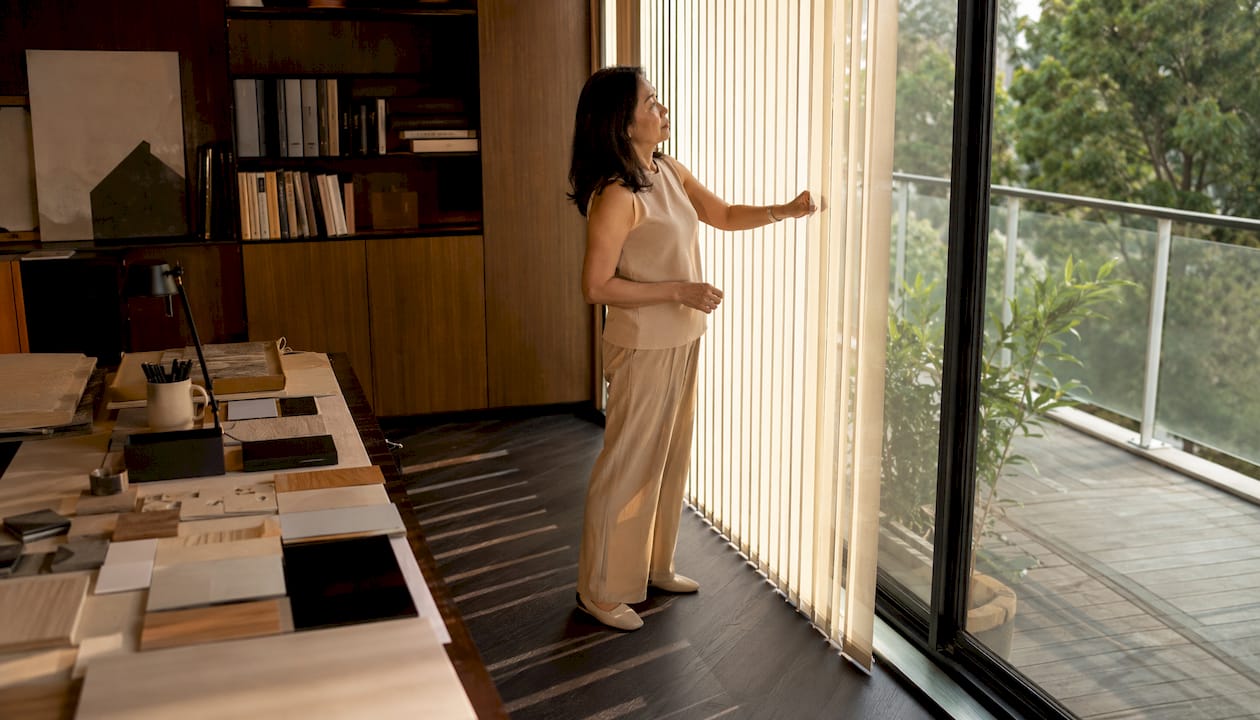
Vertical blinds hang from an overhead track and traverse horizontally, which means they stack neatly to one side or split to both sides when you open them. That movement mirrors the direction a sliding door travels, so there is no awkward bunching or interference with the door panel itself.

For Singapore homes, this matters more than it might seem. HDB and condo layouts frequently feature floor-to-ceiling windows in the living room and wide sliding doors leading to the yard or balcony. Curtains bunch at the sides and reduce usable wall space; roller blinds require the door to be closed before you can raise them. Vertical window blinds sidestep both problems.
Key functional advantages:
- Span large openings: A single track can cover a three-meter sliding door without a center seam.
- Operate independently: Split-draw tracks let you open one half while keeping the other closed.
- Handle high traffic: Vanes on a sliding door get touched constantly. PVC and faux wood vanes hold up to that contact far better than fabric panels.
- Perform in humidity: Singapore’s year-round heat and moisture accelerate warping in real wood. PVC and composite materials are unaffected.
Office managers will find vertical blinds equally practical. Open-plan offices with full-height glazing need glare control without blocking natural light entirely. Tilting the vanes 45 degrees cuts direct sun while keeping the space bright, something roller blinds cannot do at an intermediate position.
Which material should you choose for Singapore’s climate?
Three materials dominate the vertical blinds market here: PVC (vinyl), fabric, and faux wood. Each has a distinct performance profile in a tropical environment.
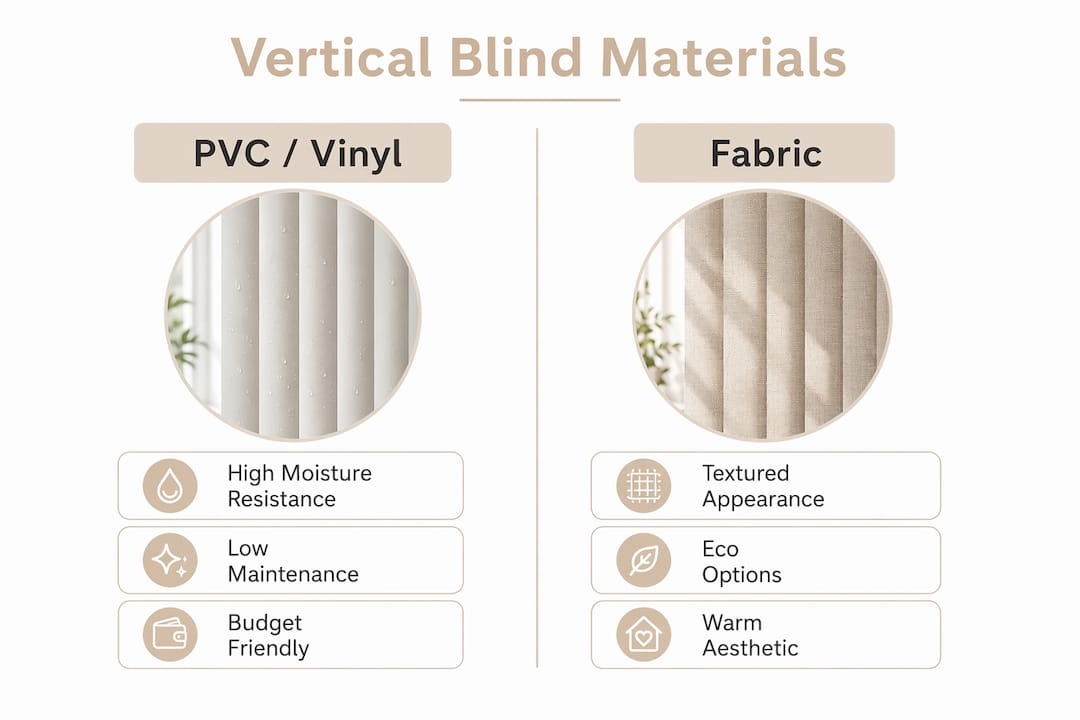
| Material | Moisture Resistance | Maintenance | Aesthetic | Best For |
|---|---|---|---|---|
| PVC / Vinyl | Excellent | Wipe with damp cloth | Clean, modern | Kitchens, bathrooms, high-traffic doors |
| Fabric | Moderate | Gentle vacuuming or spot clean | Soft, warm | Bedrooms, living rooms, offices |
| Faux Wood | Very good | Wipe with damp cloth | Warm, natural grain | Living rooms, sun-exposed areas |
PVC vertical blinds are the most practical choice for Singapore’s climate. Vinyl vanes resist moisture and are available in a wide range of colors, making them easy to match to any interior. Cleaning takes thirty seconds with a damp cloth. The trade-off is that PVC reads as utilitarian — fine for a service yard door, less so for a formal living room.
Fabric vertical blinds bring texture and warmth that PVC cannot replicate. Fabric vanes can be freehanging or inserted into vinyl carriers for added structure and light blocking. They suit bedrooms and living rooms where aesthetics carry more weight than raw durability. In Singapore’s humidity, fabric vanes need more attention — occasional vacuuming and prompt spot-cleaning after any moisture contact.
Faux wood vertical blinds sit between the two. They combine a woodgrain finish with composite construction that resists moisture and UV exposure, making them a strong choice for west-facing windows that take direct afternoon sun. The look is warmer than PVC and more durable than real wood, which can crack and warp in humid conditions.
On the eco-friendly side, some fabric vanes are made from recycled polyester or certified low-VOC materials. If environmental credentials matter to you, ask your supplier about the fabric’s composition before ordering.
How to keep your vertical blinds clean and lasting longer
Singapore’s combination of humidity, dust, and occasional haze means vertical blinds need more regular attention than they would in a temperate climate. The good news is that the routine is simple.
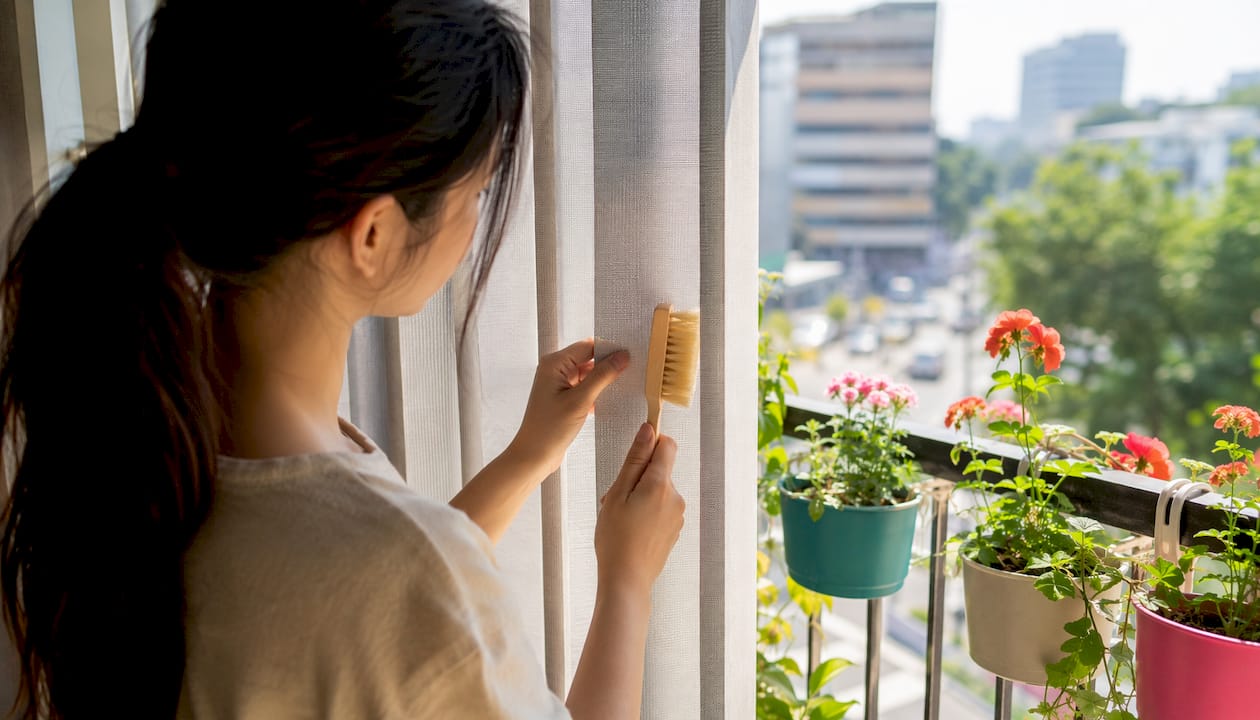
- PVC and faux wood vanes: Wipe each vane with a lightly damp microfiber cloth every two to four weeks. For heavier grime, a mild detergent solution works without damaging the surface. Regular cleaning prevents buildup that can stain vanes permanently over time.
- Fabric vanes: Vacuum with a soft brush attachment monthly. Spot-clean stains immediately with a damp cloth and mild soap. Avoid soaking fabric vanes in place — remove them from the carrier clips if a deeper clean is needed.
- Track and carrier clips: Dust the track channel every month. A dry cloth or a vacuum crevice tool clears the debris that causes carriers to stick or skip.
- Moisture prevention: After cooking or showering near a window with vertical blinds, tilt the vanes open briefly to allow airflow. Trapped moisture against fabric vanes encourages mildew.
- Professional servicing: Once a year, have the track mechanism checked. Carriers and the drive chain wear gradually, and catching a worn part early is far cheaper than replacing the whole headrail.
DIY maintenance handles most of what vertical blinds need. Where professional help pays off is in track realignment and carrier replacement — tasks that require the right tools and familiarity with the specific headrail system.
What does it cost to buy and install vertical blinds in Singapore?
Pricing for vertical blinds in Singapore depends on material, window size, and whether installation is included. The table below gives a practical overview of what to expect.
| Material | Price Range | Installation Included | Warranty |
|---|---|---|---|
| PVC / Vinyl | Budget to mid-range | Yes, with professional providers | Typically included |
| Fabric | Mid-range | Yes, with professional providers | Typically included |
| Faux Wood | Mid to premium range | Yes, with professional providers | Typically included |
Pricing is not publicly listed as a flat rate because it depends on your exact window dimensions and the number of panels required. The most reliable approach is to request a free onsite measurement, which gives you a firm quote based on your actual space.
What a full-service package from a professional provider like Primedecorfurnishing typically covers:
- Onsite measurement and consultation at no charge
- Custom fabrication to your window dimensions
- Professional fitting by trained installers
- Warranty on materials and workmanship
- After-sales support for adjustments or repairs
Pro Tip: Get quotes based on your measured dimensions, not estimated sizes. A window that looks like a standard 2.4m width often measures 2.35m or 2.5m, and ordering the wrong size means a remake.
The free home measurement service at Primedecorfurnishing removes that guesswork entirely. A fitter visits, measures every opening, and the quote reflects your actual requirements.
Can you automate your vertical blinds with a smart home system?
Yes, and it is more practical than most homeowners expect. Motorized vertical blinds operate silently via a battery or wired motor in the headrail, replacing the manual wand or cord with a remote control, a smartphone app, or a voice command through systems like Google Home or Amazon Alexa.
For Singapore homes with wide sliding doors, automation solves a specific problem: the door is often at the far end of the living room, and walking over to tilt or draw the blinds every time the sun shifts gets old quickly. A scheduled timer can open the vanes at 7 AM and close them at 3 PM when the west sun hits hardest.
Features worth knowing about:
- Remote operation: Control individual zones or all blinds simultaneously from your phone.
- Timed schedules: Set open and close times to match your daily routine or to simulate occupancy when you are away.
- Smart home integration: Compatible systems connect to existing hubs, so your blinds can respond to temperature sensors or light levels automatically.
- Silent traversal: Quality motorized tracks produce minimal noise, which matters in bedrooms and meeting rooms.
- Maintenance note: Motorized headrails need occasional battery replacement or wiring checks. Keep the track clean to reduce motor strain.
If you are already planning a smart home setup or a renovation, it is worth specifying motorized vertical blinds from the start. Retrofitting a motor into an existing track is possible but more involved than installing one during the initial fit. For a broader look at automated window covering options, the motorised roller blinds guide covers compatible systems available in Singapore.
Why S-shaped vanes give your vertical blinds a more polished finish
Standard vertical blind vanes are flat. They do the job, but up close they look exactly like what they are: a row of plastic or fabric strips. S-shaped vanes change that by curving each slat into a gentle S profile, which creates a softer, drapery-like appearance when the blinds are closed.
The practical difference goes beyond looks. The curved profile means adjacent vanes overlap slightly when closed, producing a tighter seal against light gaps at the edges. Flat vanes leave small slivers of light between each slat; S-shaped vanes close those gaps without requiring the vanes to be pressed together. For a bedroom where blackout performance matters, that detail is worth paying attention to.
S-shaped vanes also read differently in a room. Flat slats suit a utilitarian office or a service area. The S-curve softens the look enough to work in a formal living room or a hotel-style master bedroom, where you want the function of a blind but the visual warmth of a curtain. Singapore interior designers increasingly specify them in condo renovations for exactly that reason.
Pro Tip: When selecting S-shaped vanes, check that the carrier clips on your chosen headrail are designed for curved vanes. Not all tracks accommodate the wider profile, and forcing flat-vane carriers to hold an S-curve vane causes premature clip wear.
The design also bridges the gap between a purely residential and a professional setting. An office that wants a polished, finished look without the maintenance demands of fabric curtains will find S-shaped vinyl vanes a practical middle ground.
Primedecorfurnishing brings it all together for Singapore homeowners
Choosing the right vertical blinds is one thing. Getting them measured, fabricated, and installed correctly is where most projects either succeed or stall.
Primedecorfurnishing handles the entire process from a single point of contact. The team visits your home or office, measures every opening accurately, advises on material and vane style based on your room’s orientation and use, and installs the finished blinds with no guesswork on your end. With over 5,000 satisfied customers and recognition in The Straits Times for pricing transparency, the track record speaks for itself.
The full package includes free consultation, onsite measurement, custom fabrication, professional installation, and a product warranty. There are no hidden charges added after the measurement visit. Browse the complete range of window treatment options or book your free home measurement directly at primedecorfurnishing.com/curtains-and-blinds-singapore to get a firm quote based on your actual windows.
Key Takeaways
Vertical blinds remain the most practical window covering for large windows and sliding doors in Singapore, with material choice and professional installation determining long-term performance.
| Point | Details |
|---|---|
| Best use case | Vertical blinds suit floor-to-ceiling windows and sliding doors better than any other window treatment. |
| Material for Singapore’s climate | PVC and faux wood resist humidity and UV; fabric suits bedrooms where aesthetics matter more. |
| Maintenance frequency | Wipe PVC and faux wood every 2–4 weeks; vacuum fabric vanes monthly and spot-clean immediately. |
| Automation is practical | Motorized vertical blinds integrate with smart home systems and solve the daily inconvenience of manual operation on wide doors. |
| Primedecorfurnishing | Offers free measurement, custom fabrication, professional installation, and a product warranty across Singapore. |
Recommended
Ready to transform your home?
Chat with us on WhatsApp for a free consultation or quote.
Chat with us on WhatsApp